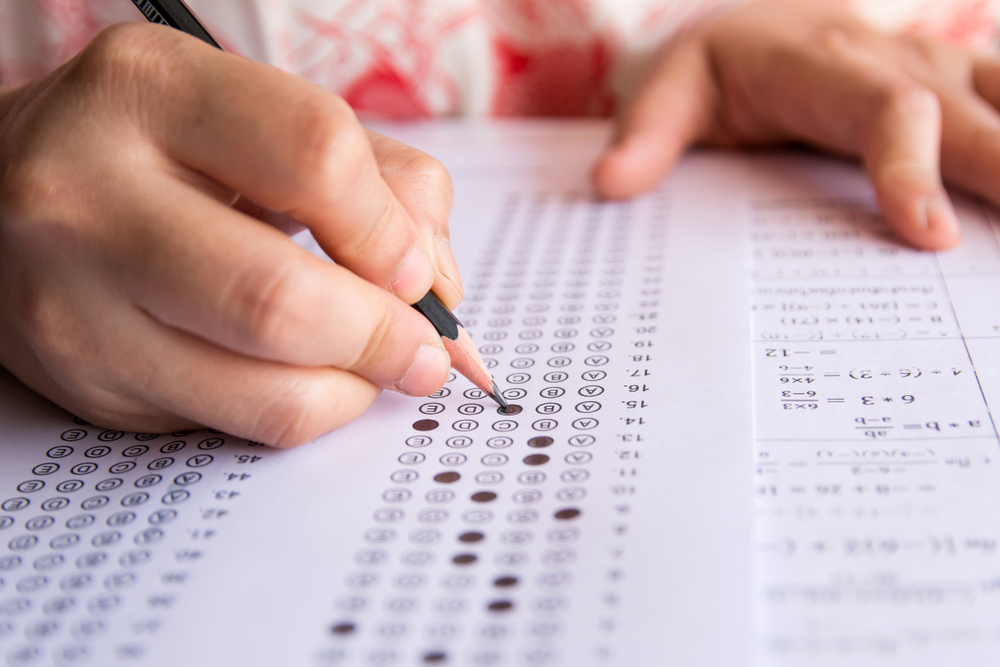
Even before the arrival of the coronavirus, the usefulness and necessity of college entrance testing was a hotly debated and litigated subject.
Health, safety and economic pressures resulting from the spread of COVID-19 have intensified this trend toward less reliance by colleges on test scores for admissions.
With the addition of a growing number of court cases related to college testing, there is a near-perfect storm that could sharply diminish the importance of college entrance testing. Many colleges are dropping testing requirements entirely, while others are making the practice optional.
What are college admissions testing organizations all about?
Currently, about half of all 2,330 four-year colleges and universities in the United States no longer require college test scores for fall 2021 admission, have declared college entrance testing as either unnecessary or optional, or have set more flexible rules for testing.
RELATED: Coronavirus forces courts to consider remote jury trials
RELATED: Lawsuit could affect how people vote in November during the pandemic
According to FairTest (the non-profit National Center for Fair and Open Testing), colleges that de-emphasize college admission testing now include such luminary institutions as Amherst, Brown, CalTech, Carnegie Mellon, Columbia, Cornell, Dartmouth, George Washington, Pennsylvania, Rhodes, Scripps, Vassar, Williams and Yale.
“At Dartmouth, we will welcome any testing element a student chooses to share — the SAT, the ACT, a subject test, an AP score — or none at all. Our admission committee will review each candidacy without second-guessing the omission or presence of a testing element,” said Lee Coffin, Dartmouth’s Vice Provost for Enrollment & Dean of Admissions and Financial Aid.
More than 300 deans of college admissions, including the dean at Harvard’s Graduate School of Education, issued a statement in June that “no student will be disadvantaged because of a change in commitments or a change in plans because of this outbreak, their school’s decisions about transcripts, the absence of AP or IB tests, their lack of access to standardized tests (although many of the colleges represented here don’t require these tests), or their inability to visit campus.”
The movement toward optional testing began in the 1960s when Bowdoin College in Maine dropped testing requirements, according to a 2015 report in The Washington Post. Other mostly smaller colleges joined the movement, including Bates, Smith, Bryn Mawr and Brandeis.
Hampshire College, a liberal arts college in Massachusetts, became “test-optional” in 1970 and went totally “test-blind” in 2014, refusing to even review test results.
“It is no secret that many colleges base financial aid awards largely or partly on test scores. Financial aid should be used to support students who most need assistance, not to reward those who are good test takers,’’ Meredith Twombly, dean of admissions and financial aid, said at the time. “The SAT is essentially one test on one day in a given year. Students' high school academic records, their history of civic engagement, their letters of recommendation from mentors and their ability to represent themselves through their essays trump anything the SAT could tell us."
This clear trend away from using test scores to determine college admission is reinforced by the legal system, both civil and criminal. Here are just a few examples:
- Dozens of wealthy, celebrity parents are either behind bars or facing federal criminal charges for cheating on behalf of their college-bound children. Chief among the crimes charged by the U.S. attorney’s office in Massachusetts are bribery, falsifying college test results and lying on college applications.
- Those criminal actions in turn prompted a California teacher and mother to file a $500 billion lawsuit (since dismissed) against many of the celebrity parents, alleging their cheating prevented her son from being accepted at top schools.
- Another group of California parents and students are suing College Board Inc., a leading college admissions testing organization, for more than $500 million, alleging the organization committed such “illegal activities” as breach of contract, gross negligence, misrepresentation and violating the American Disabilities Act. The class-action lawsuit is based on problems that occurred during administration of at-home advanced placement tests taken by students during the coronavirus scare this spring.
- Last year, a New Jersey student and his parent sued ACT, which also offers college admissions testing, after ACT challenged the student’s test score and said he would have to prove it was valid or retake the test. The case is now on appeal.
- Days after a court ruling that opened the door for low income, minority and disabled students to sue the University of California system for discrimination for basing admissions on SAT and ACT scores, the systems’ Board of Regents unanimously suspended test requirements for students entering in 2023 and 2024. Until then, student submission of test scores will be optional.
Meanwhile, reacting to the spreading coronavirus, the College Board cancelled its planned May and June SAT testing because of fears about students’ health and safety. With the continued and increasing spread of the coronavirus and uncertainty about the opening of schools in August, it is not clear that the organization will be able to offer in-school testing planned for the fall.
The organization has asked colleges to extend their deadlines for submission of test scores. It is offering limited in-person testing at some centers. The group also halted offering at-home SAT testing after it became clear that it was impossible to guarantee test-takers would have uninterrupted three-hour, video-quality internet connections.
"We know demand is very high and the registration process for students and families under this kind of pressure is extremely stressful," College Board CEO David Coleman said at the time. "There are more important things than tests right now."